
This page is to support you to understand information within the behaviour form emails you have recieved from the School. From 1st April 2026, all Schools are required to share, in writing, with families information in connection with behaviour management records.
This new guidance does not change how we support pupils. We will continue to use physical interventions only as a last resort, when they are reasonable, proportionate and necessary. Where this is used as a planned approach, it will continue to be detailed in your child’s support and intervention plan.
A copy of the DfE Guidance that the School is working within can be found here
A copy of the letter sent out by Sheringham Woodfields School prior to the introduction of these changes can be found here
To support with understanding the information that you have recieved, we have annotated the layout below
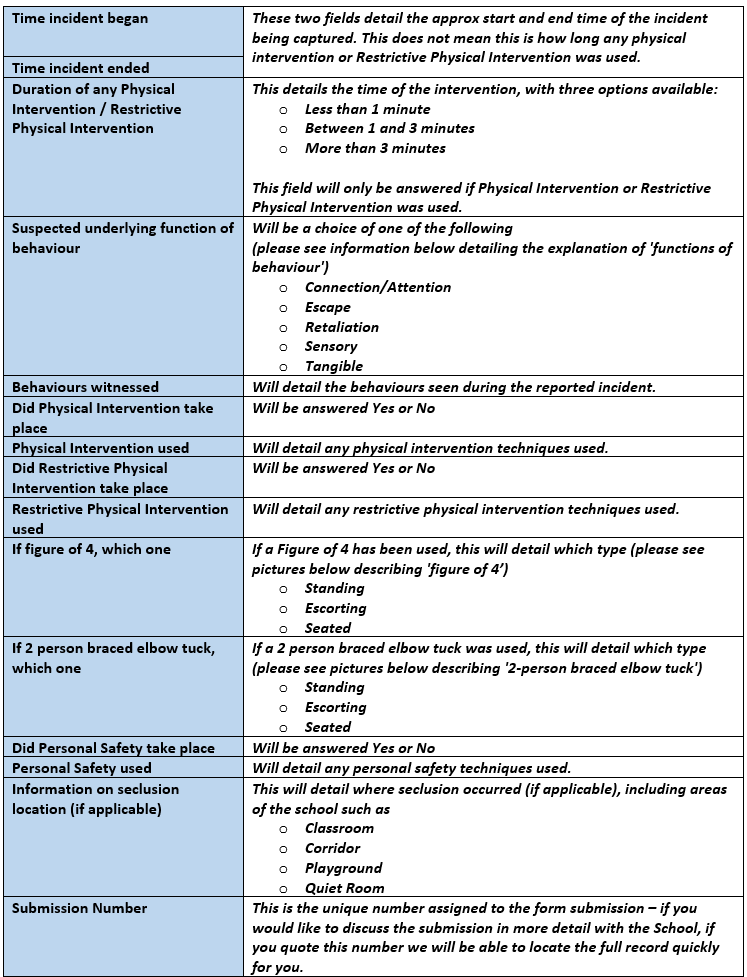
A reminder of some of the core terminology used within the updated DfE Guidance is below:
Restrictive intervention: a means to prevent, restrict, or subdue movement of the body, or part of the body, of a pupil. This guidance uses ‘restrictive interventions’ as the umbrella term to describe both physical and non-physical actions aimed to restrain pupils in different ways.
Reasonable force: a term used in legislation, which includes physical restrictive interventions. All members of school staff have the legal power to use reasonable force in limited circumstances. Reasonable means using no more force than is necessary for the least amount of time, the application of which will depend on the circumstances.
Seclusion: a non-disciplinary intervention involving keeping a pupil confined to a place away from others, and preventing them from leaving either by physical obstruction or blocking.
Restraint: a term used in legislation referring to a non-disciplinary intervention, which immobilises a pupil or limits their movement. This may or may not include direct physical contact.
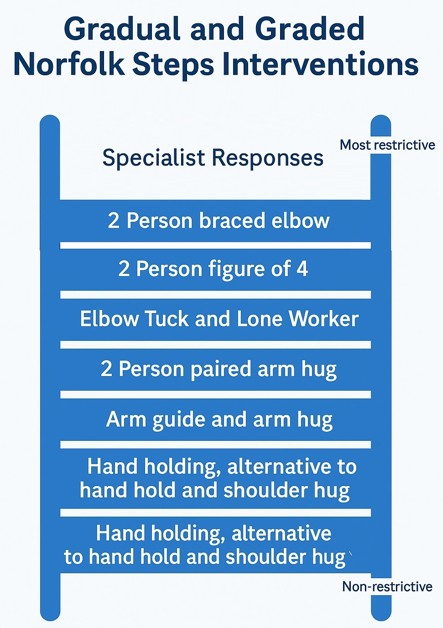
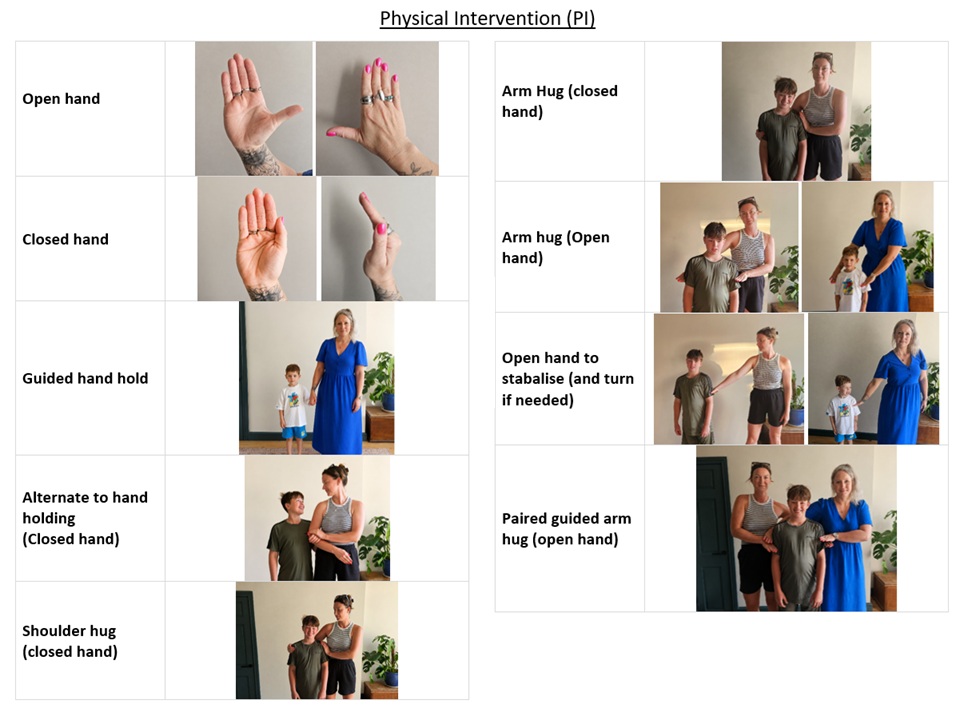
Below is information about the ladder of approaches available to staff within the School.
When referring to the underlying function of behaviour, please find more information below.
Behaviour is communication, and the underlying motivation for all communication is driven by feelings
We categorise those feelings into the following interpretations, it can be difficult sometimes to be completely confident in our understanding of the function of the behaviour but we will use our professional judgement to align it to the function we feel is most likely to have been the cause.
Connection/Attention:
The motivation is to gain the attention of, or connection with, another person. This can present as positive or negative behaviours.
Escape:
These are avoidant behaviours i.e. the child wishes to ‘escape’ from having to do a particular task or activity. For example, not wanting to get dressed or do school work.
Retaliation:
Behaviour driven by a motivation to respond to another’s behaviour that they deem as unfair e.g. hitting someone who has hit them i.e. a response to anything they feel was unjust.
Sensory:
A behaviour caused by being under or over stimulated or being overwhelmed. Their presentation in those moments is an attempt to change the way they are feeling by doing something else. This is also the behaviour most closely aligned to Interoception, which is how we respond to the feelings or signals generated by our bodies.
Tangible:
This is when the behaviour is generated by a motivation to have something e.g. a drink, food, a toy being used by another child. It also includes the wish to not just have an object but to also have a desired activity or experience.